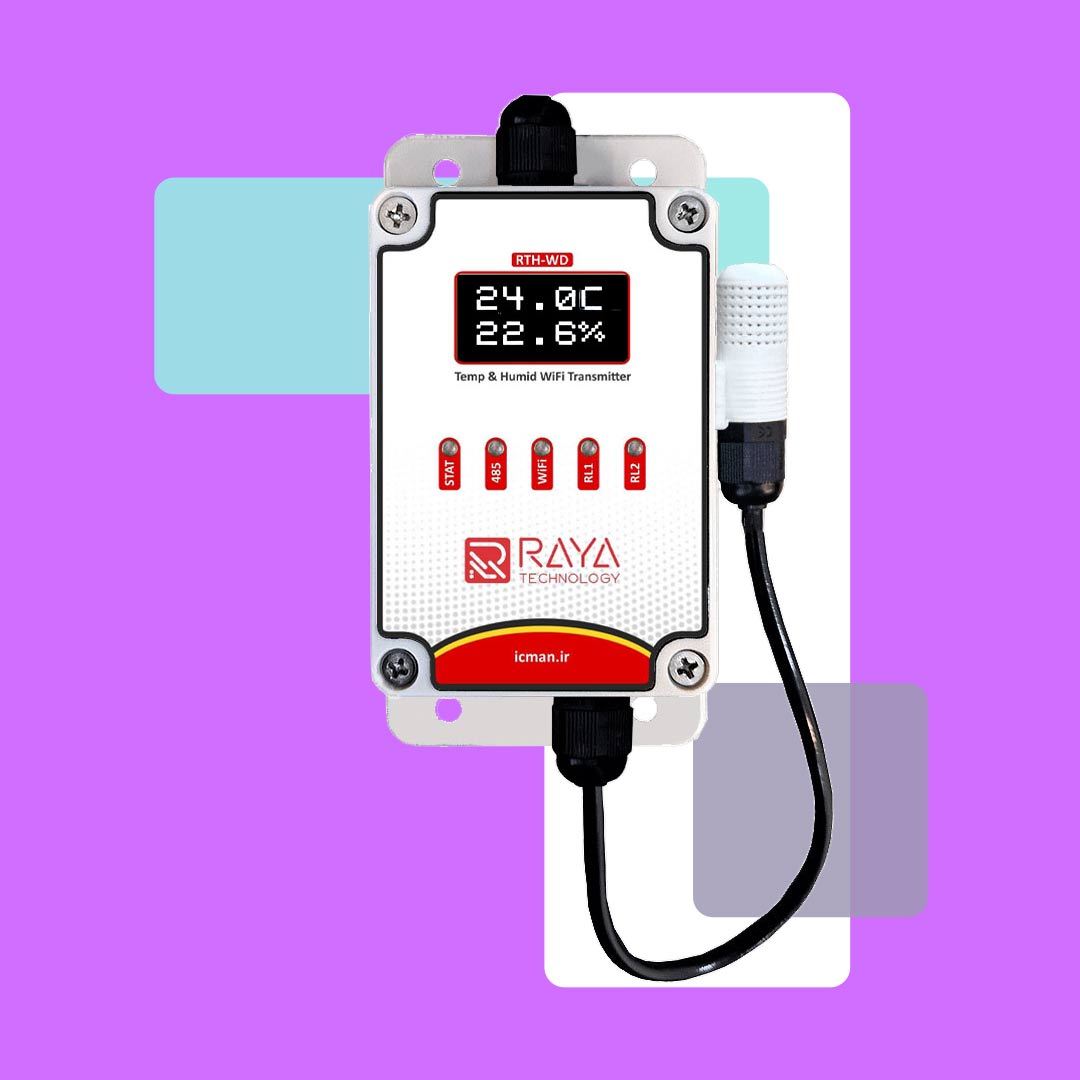
In the WiFi sensor, a Swiss chip from Sensirion is used, with a temperature measurement range of -20 to +85 degrees Celsius, and the humidity measurement range of this sensor is 0 to 100 percent.
The actual temperature measurement accuracy is ±0.3 degrees Celsius and the humidity measurement accuracy is ±3 percent.

Support for Modbus TCP Protocol over WiFi

Temperature : -20 to +85 °C
Humidity : 0 to 100%

Input Voltage: 220V

Two 1A Relay Outputs

Equipped with a professional web service for configuration via browser
Ethernet network as WiFi under the Modbus TCP, JSON, and HTTP software protocol
The communication protocols embedded in this device provide the capability to connect to various PLCs, DCSs, and RTUs, and it can also communicate with various equipment that supports Modbus TCP, JSON, and HTTP.
The measurement accuracy of this sensor is suitable for server rooms, livestock and poultry farming centers, mushroom cultivation halls, greenhouses, and all warehousing and industrial environments, laboratories, cold storage facilities, office and residential buildings, etc.
Note
– Since this device has a series of thermostatic modes, in cases where temperature or humidity control is required, this sensor can be used.
– This sensor is specifically designed for displaying and monitoring temperature and humidity in industrial systems.
The relays in the WiFi sensor have three different control modes:
Mode 1: Under the Modbus network
Mode 2: Based on ambient temperature
Mode 3: Based on ambient humidity
Each relay has the capability to define a mode for it separately. For example, the settings of one relay can be configured based on temperature and the other based on the Modbus network.
When the relays are set based on ambient temperature and/or humidity, they operate in such a way that a range is defined for them: a temperature is received as the Max temperature, for example 25 degrees, and a temperature is received as the Min temperature, for example 23 degrees; based on this information, the temperature range of 23 to 25 degrees becomes the control range. Humidity can be configured in the same way.
Note: The difference between these two numbers cannot be less than 1 degree for the temperature mode and cannot be less than 5 percent for the humidity mode.
In thermostatic modes, there are two modes, decreasing and increasing, which we have explained in the relevant section.
If you want to use this sensor on the network (you define an IP for the device), by entering the IP, the web service opens and all settings can be performed through the web service. One of the applications of the web service is that, for example, if these sensors are used in an organization’s or a refinery’s internal Ethernet network, all settings can be defined remotely exactly through the network.
If in the environment where you are using this sensor there is a modem with a valid IP, by applying a series of network settings you will have the possibility to remotely connect to the web service of this device via the internet, view the temperature and humidity values, and apply any settings to the device.
جهت دریافت تمامی ویدئوهای فعلی و جدیدترین ویدئوهای ضبط شده با موضوعات اتصال و راه اندازی محصول و ارتباط با انواع PLC و HMI کلیک کنید.
Yes. These sensors can be connected to various computers (regardless of the operating system) using RS-485 to USB converters.
Your technical questions about the product can be sent as text messages (SMS or social media) to the support team, and the technical experts will respond through the same channels. If needed, they will contact you directly.
Sales and Support Team Number:
+989177391091
Yes. Since the device enclosure has an IP66 protection rating against water and dust ingress, this product can be used in outdoor environments. However, it is not recommended to expose it continuously to rain or direct water spray.
Due to the protective cover on the sensor, sudden sprays of non-acidic liquids are repelled and do not cause any damage to the sensor.
Since this sensor communicates via the Modbus protocol with devices such as PLCs, RTUs, and HMIs, you can view the measurements on industrial HMI displays and your personal computer monitor.
Yes. One meter of flexible four-core cable (power + RS-485) with a thickness of 0.25 mm² is included with the product.
Via the Modbus-RTU network
Yes, the sensor’s slave address can be changed via software using Modbus commands.
The components used in this sensor are manufactured in the USA and Switzerland.
Yes, according to Modbus protocol standards, this is possible. For more information and details on how to differentiate sensor data, you can refer to the sensor setup tutorial file.
You can find all tutorials and necessary files on the product page under the “Product Videos” and “Downloadable Files” tabs. Click here.
Some PLCs have an RS-485 port, allowing the sensor to connect directly. However, for PLCs without an RS-485 port, the sensors must be connected via RS-485 expansion cards.
Due to the sensor’s casing material, it cannot be installed directly inside a furnace. However, the company can provide the sensor with a half-meter cable, allowing customers to place the sensor circuitry outside while installing the sensor itself inside the furnace.